
Do Faceless YouTube Channels With AI Make Money in 2026?
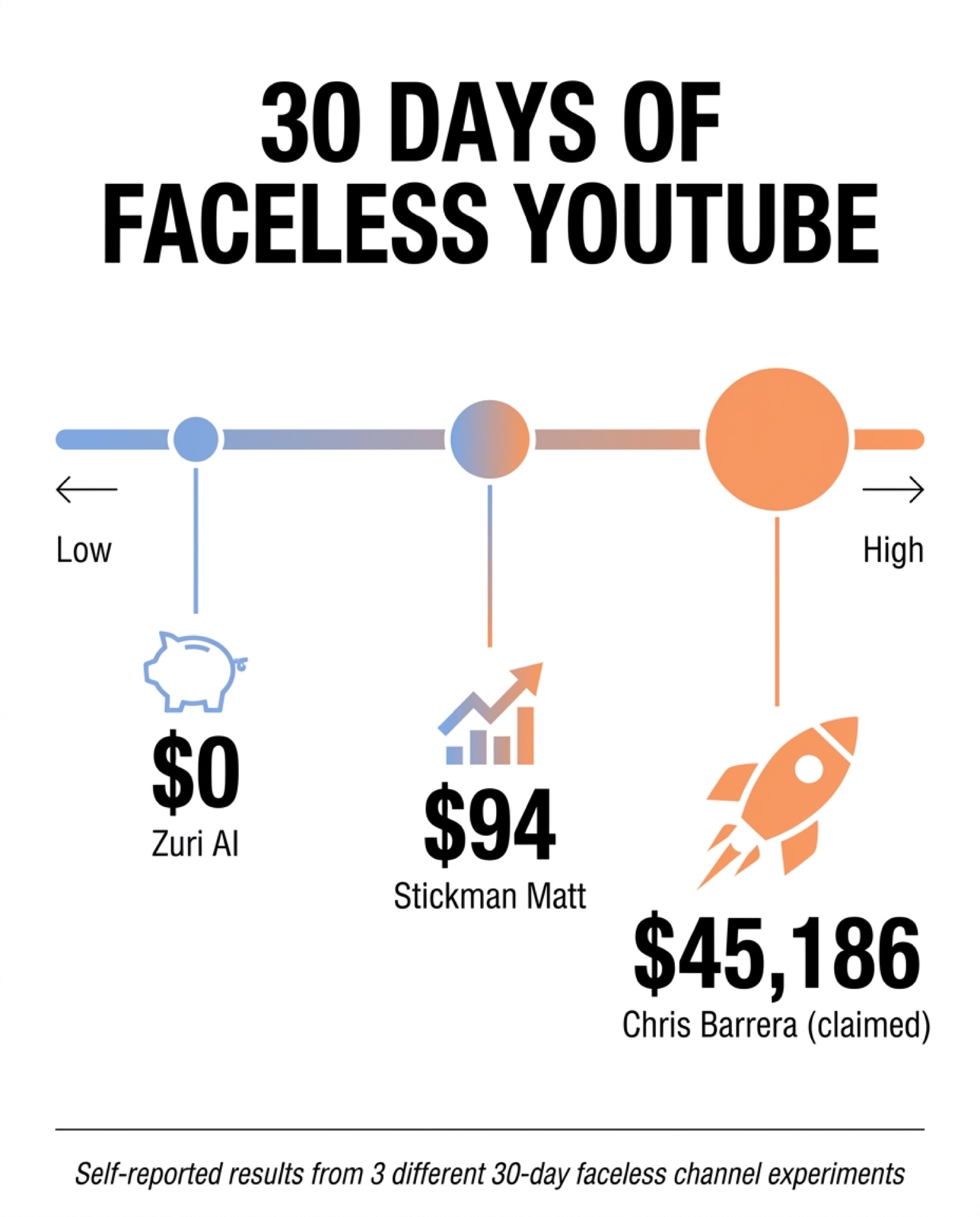
Some faceless AI YouTube channels do make money. The range is enormous: one creator documented $94 in affiliate revenue after 30 days of consistent posting, while another claims a single channel made $45,186 in its first month. Both are real, attributed results from working creators, not typical outcomes. What actually determines which end of that range you land on is niche selection, how much of the process stays human, and whether you treat it as a real business with a multi-month runway.
We reviewed 19 videos (about 5.5 hours) from 17 creators who documented running faceless AI channels for anywhere from 24 hours to 3 years, including two videos explicitly framed as honest 30-day experiments. No live web research layer was added on top, this is a transcript-only synthesis. Every claim below is paraphrased and linked to the creator who made it.
Do Faceless YouTube Channels With AI Actually Make Money?
Yes, but the honest 30-day experiments earn far less than the promotional ones suggest. Stickman Matt ran a brand-new AI-tools channel for 30 days and closed it out with 14 videos, 103 subscribers, about 4,000 total views, and $94 in affiliate commissions, roughly $3 an hour once he counted the 30 to 40 hours he put in. Zuri AI ran the same kind of 30-day test and made nothing at all, describing the real result as “not money, not fame, but clarity.”
At the other end, Chris Barrera says one of his channels made $45,186 in a single month, and that his full portfolio of channels collectively earns “six figures per month.” Those numbers come from his own dashboard screenshots in the video, not from an independent source, and he’s also selling coaching in the same video, so treat the figure as his stated claim rather than a typical result.
How Much Do Faceless YouTube Channels Really Make in the First 30 Days?
| Creator | Video | Timeframe | Stated result |
|---|---|---|---|
| Stickman Matt | I Tried Faceless YouTube Automation for 30 Days | 30 days | $94 affiliate revenue, 103 subscribers |
| Zuri AI | I tried Faceless YouTube Automation For 30 Days | 30 days | $0, low single-digit views per video |
| Chris Barrera | $0-$45,186 In 30 Days | 30 days | $45,186 on one channel (his largest claim) |
| Think Media | YouTube’s NEW Rules for AI Videos | 2 AI shorts | $0.80 and $0.40 combined |
| bizzy | I Ran A Faceless Youtube Channel For 200 Days | ~200 days | ~$1,500 total, split between two people |
| Darragh Lucey | I tried Faceless YouTube Automation for 200 days | ~200 days | Spent $7,000-$10,000, recovered under a fifth of it |
| InVideo For Content Creators | Why 99% of Faceless Channels fail | ~8 months | ~$800 spent before first dollar, profitable at month 8 |
Notice how far apart these are even among creators being deliberately honest. That spread, not any single number, is the real finding.
Why Do Some Faceless Channels Make Five Figures and Others Make Nothing?
The creators who report the biggest numbers share a few traits the near-zero results don’t have. Chris Barrera targets niches with an older, high-income audience, arguing that a niche like Amish lifestyle or home cleaning content can carry a $10+ RPM (revenue per thousand views) once the audience skews 40 to 60 years old. Make Money Matt goes further and calls this a “money niche,” building a channel specifically around personal finance for people over 50 because there’s something to sell beyond ad revenue. Romayroh says his channel got monetized with just 3 videos in under 2 weeks after building it around what he calls a “ghost niche,” a genuinely untapped topic instead of a copy of an existing channel, which he says earns “information gain” credit from YouTube’s algorithm for covering something the platform doesn’t already have indexed.
The near-zero results share a different pattern: no niche filter beyond “AI tools are trendy,” fully outsourced production from day one, and quitting or losing focus before month three. Darragh Lucey describes losing an entire video’s finished assets when a freelance editor stopped responding after a month of paid work on it, and separately watched six videos on an earlier channel get zero views after the team chased one viral hit instead of nurturing the audience it had already built. Alston Godbolt, who has run 4-5 faceless channels for several years, puts it plainly: “Making money online is simple. It’s not easy.”
How Long Does It Actually Take to Get Monetized?
This is where the biggest disagreement in the research shows up. Romayroh reports monetization in under 2 weeks with 3 videos. Syrax claims 5 days. InVideo For Content Creators, by contrast, needed roughly 20 videos, about $800 out of pocket, and 8 months before the channel turned a profit. bizzy took 3 months to first get monetized, and only after a trend-jacked video (about an already-popular YouTuber) spiked to over 100,000 views.
The fast claims tend to come from creators who are also selling a course or coaching program in the same video. The slower, more granular timelines come from the two videos explicitly framed as honest 30-day tests and the two 200-day retrospectives, which is worth weighing when you’re deciding which timeline to plan around.
One counter-example matters more than the rest: hitting a view or watch-hour target doesn’t guarantee approval. Syrax’s second channel reached 10 million views in 40 days, the threshold for the monetization program he was targeting, and was still rejected when he applied. He pivoted to a per-view rewards program instead and reports making more from that ($2,738) than from AdSense ($200) on the same content.
Is Buying an Aged Account or Subscribers Safe?
No, and this is the single most contested tactic across the whole research set. Syrax recommends buying an “aged” YouTube account, one that’s 2 to 15 years old, because YouTube reportedly trusts established accounts more than brand-new ones, and in a separate video he describes using a proxy tool to mask his IP address after suspecting a shadowban on a new channel.
Alston Godbolt directly contradicts this approach. He says he personally paid $2,000 for a course that taught buying subscribers and watch hours through paid services, and that this is a stated violation of YouTube’s Partner Program terms that can get a channel deleted or demonetized. Neither creator addresses the other’s video, but the two pieces of advice can’t both be safe to follow. If a video tells you to buy an account, subscribers, or watch hours, treat that as the riskiest tactic in this entire space, not a shortcut.
Does YouTube Actually Ban AI-Generated Videos?
Not outright, according to two independent sources in this research. Jack Craig built an AI pet-grooming Shorts channel from zero and got 700,000 views in 48 hours, then walked through YouTube’s “inauthentic content” policy, arguing it targets content with minimal variation across uploads or content that’s easily replicated at scale, not AI-assisted production with genuine human editorial input.
Think Media reaches the same conclusion citing AI YouTuber Matt Wolf, who has an 800,000-subscriber AI-focused channel: YouTube’s crackdown is aimed at repetitive, reused content, not AI tools themselves. Think Media’s own test, two AI-generated Shorts that earned $0.80 and $0.40, is a useful reality check on how small individual AI Shorts payouts can be even when the content is allowed to monetize.
Several creators go further and argue full automation is actually what triggers demonetization. Chris Barrera opens his $45,186 video by listing why 100%-AI-automated channels fail, and Romayroh states it as a rule up front: “Don’t let AI run your YouTube channel.” The pattern across the research is that AI speeds up scripting, voiceover, and visuals, but the creators reporting real revenue all describe reviewing, editing, or rewriting AI output before it goes live.
What Actually Works, According to the Creators Who’ve Done It
Across all 19 videos, a few practices show up again and again regardless of how much money the creator ended up making:
- Start affiliate income immediately. Stickman Matt, Joshua Mayo, and InVideo For Content Creators all add affiliate links from video one, since AdSense eligibility can take months and isn’t guaranteed.
- Model proven formats, don’t copy them. Chris Barrera, Syrax, and Jack Craig each describe studying a competitor’s transcript, title, and thumbnail pattern, then rebuilding it for a new topic or angle. Word-for-word copies, several note, don’t get pushed by the algorithm.
- Expect flat weeks before anything happens. Rob the Maritimer’s channel (a face-on-camera tutorial channel, not a faceless one, included here only for contrast) took 4 months of consistent output before monetization, then a single video spiked watch hours by 10x. That same flat-then-spike pattern shows up in the faceless data from bizzy and Darragh Lucey too.
- Understand the process before outsourcing it. InVideo For Content Creators recommends writing your own scripts and reviewing your own analytics for the first few months, so you can actually brief a freelancer once you start paying for one.
- Packaging decides who clicks. Nearly every creator in this research treats the title and thumbnail as a separate skill from the video itself. If you’re building the visual side, our guides to designing YouTube thumbnails that get clicks and keeping an AI character consistent across images cover the parts that trip most people up.
- A consistent AI host beats stock footage. Several creators above build a channel around one recurring AI character instead of licensed b-roll. Our sister site’s free character sheet generator locks that face down before you start generating video, and its 3-second AI hook prompt library covers the opening seconds that decide whether someone keeps watching.
Frequently Asked Questions
How much do faceless YouTube channels make per month?
It varies by orders of magnitude and depends heavily on niche RPM. In this research, monthly results ranged from $0 (Zuri AI) to a claimed $45,186 on one channel (Chris Barrera), with most honest, non-promotional accounts landing in the low hundreds of dollars in the first few months.
Is faceless YouTube automation worth starting in 2026?
It can be, but almost none of the creators in this research who were candid about costs reported being profitable within the first 60 days, and the ones who did move fast already had prior YouTube experience going in. Darragh Lucey put it directly: expect to spend real time or real money, most likely both, before you see it work.
What are good faceless AI YouTube channel niches?
The creators in this research who reported the strongest results picked niches with a clear path to a sale beyond AdSense, evergreen appeal so they aren’t chasing trends every video, and a real audience gap where small channels were already getting disproportionate views relative to subscriber count. Chris Barrera checks a channel’s subscriber-to-video ratio before committing to a niche; Steffen Miro looks for niches where new channels are already outperforming their subscriber count within the first month.
Does buying subscribers or an aged account speed up monetization?
It might speed up the numbers, but at least one creator in this research explicitly states it’s a Partner Program violation that risks account deletion or demonetization. See Is Buying an Aged Account or Subscribers Safe? above before trying it.
Can a faceless channel get monetized and then still get rejected?
Yes. One creator’s channel hit 10 million views in 40 days, the exact threshold for the program he applied to, and was rejected anyway. See the monetization timeline section above for what he did next.
Sources: all claims above are attributed and linked to the individual creator’s video where the claim was made. Figures from promotional or coaching-adjacent videos (marked accordingly) are the creator’s own stated numbers, not independently verified.
Faceless YouTube is one of several AI-assisted income methods people are testing right now. If you want the wider picture, see our roundup of what 19 creators found running AI side hustles for 30 days, which covers dropshipping, AI-generated content sales, and freelance methods alongside faceless video.