AI Side Hustles: What 19 Creators Found After 30 Days
Yes, AI side hustles can produce real income, but the honest range across 19 documented tests runs from a $157 profit on a 7-day budget to a claimed $52,000 a month, using the identical tactic. The gap has almost nothing to do with which AI tool got used and almost everything to do with distribution, the specific niche picked, and how many weeks the creator stuck with it before quitting.
To put this together, we reviewed 19 videos (about 6.5 hours) from 17 creators who each ran their own AI side hustle experiment (mostly 30 days, some 14 or 7) and published their actual numbers. This is not a first-hand test. It is a synthesis of what those creators found, with every claim linked back to its source so you can watch the full breakdown yourself.
Do AI side hustles actually work?
Yes, every single one of the 19 tests produced some income, but “some income” ranged enormously. Mark Tilbury’s 7-day AI-influencer challenge cleared $157.48 in profit against a $99 budget (Mark Tilbury). AI Wealth Odyssey ran five different AI side hustles in parallel for 30 days and every single one, from a $4-sale Amazon KDP ebook to 19 Etsy digital-product sales, was still generating something on day 30 (AI Wealth Odyssey). The pattern that shows up again and again is not “does this work,” it’s “how long until it works, and for how much.”
What did most creators actually agree on?
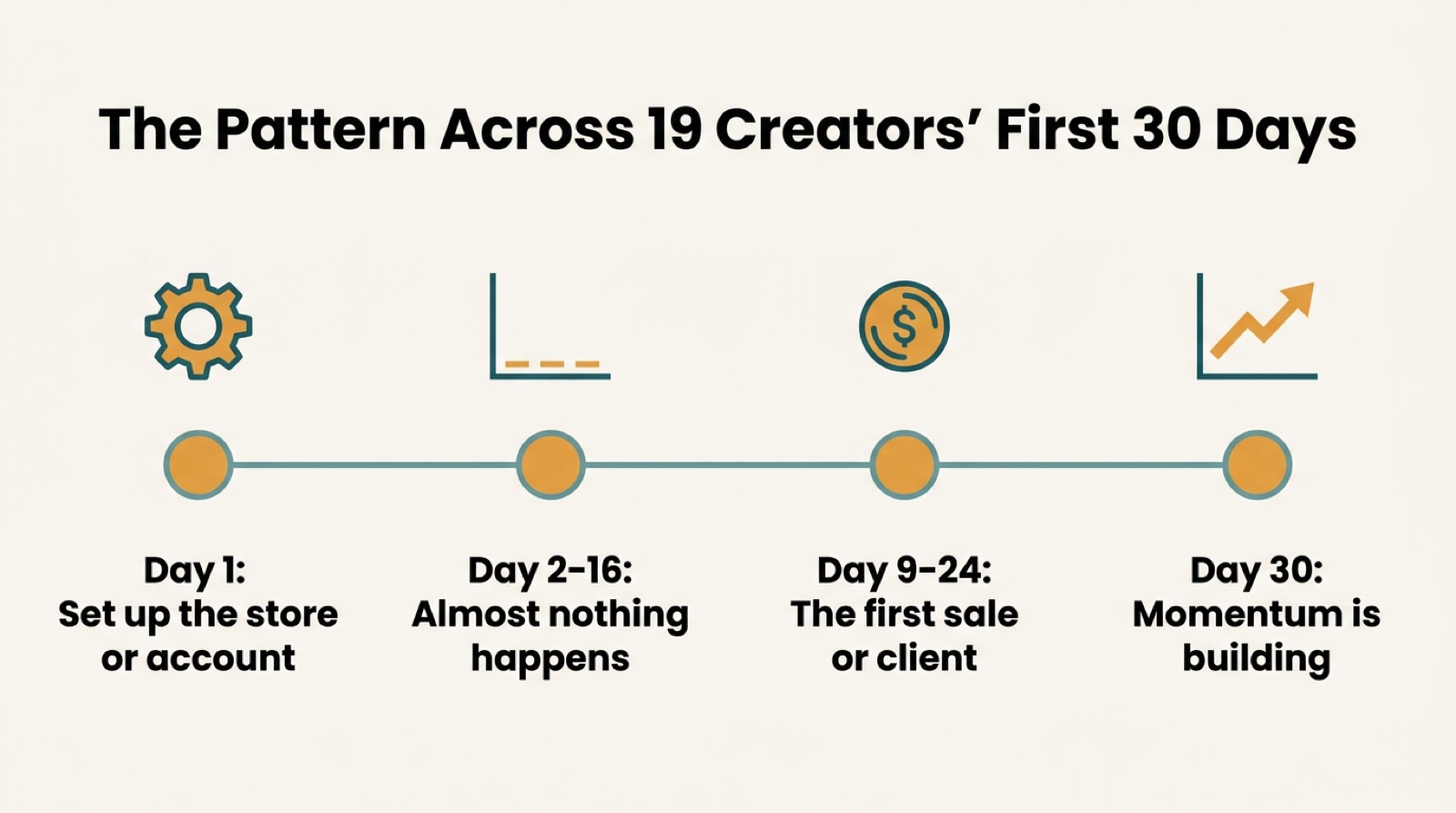
Across unrelated channels, the same three lessons kept repeating: the first few weeks produce nothing, AI does the production but not the distribution, and quitting early is the single biggest reason people conclude “AI money doesn’t work.”
The dead zone is real and it lasts 1 to 3 weeks. AI Wealth Odyssey’s Etsy digital-product listing got its first sale on day 12, its Fiverr AI-service gig got its first order on day 9, its Amazon KDP ebook waited until day 17, and its affiliate links didn’t convert until day 22 (AI Wealth Odyssey). AI Unfiltered’s freelance-writing gig sat with zero inquiries for the first three days of a 30-day test before the first client appeared (AI Unfiltered).
AI does the making, not the selling. The How To Channel frames it directly: “the AI doesn’t get you the clients, your reputation does” (The How To Channel). BOOST MIND found the exact same thing from the opposite angle: an AI-written batch of client emails took roughly two hours of manual editing per client to sound natural enough to send, and landing those two paying clients still required cold-pitching five local businesses by hand (BOOST MIND).
Quitting in week two is the actual failure mode. Stickman Matt’s faceless YouTube channel had 12 views in its first 24 hours and did not break 100 views total until day 7 (Stickman Matt). Every one of AI Wealth Odyssey’s five parallel hustles was, in their words, “still building momentum on day 30,” meaning the people who stop at day 15 never see the part where it starts working (AI Wealth Odyssey).
Why did the identical AI side hustle make one creator $157 and another $52,000 a month?
Because the AI tool was never the variable that mattered, distribution was. Both used Claude AI to generate a PDF guide and sold it through a simple online storefront. Mark Tilbury’s version, built inside a 7-day, $99-budget challenge with three brand-new Instagram accounts and zero existing audience, sold 23 copies of a $12 workbook for $276 in revenue and $157.48 in net profit (Mark Tilbury). Money Talk With Leon’s version used the same core workflow (a tool called PDF Trend Lab to find the topic, Claude to write it, a Shopify storefront to sell it), but marketed it by paying niche YouTube influencers to feature the product to their existing audiences, and reported $211,572.11 in revenue across 4 months, an average of roughly $52,000 a month (Money Talk With Leon).
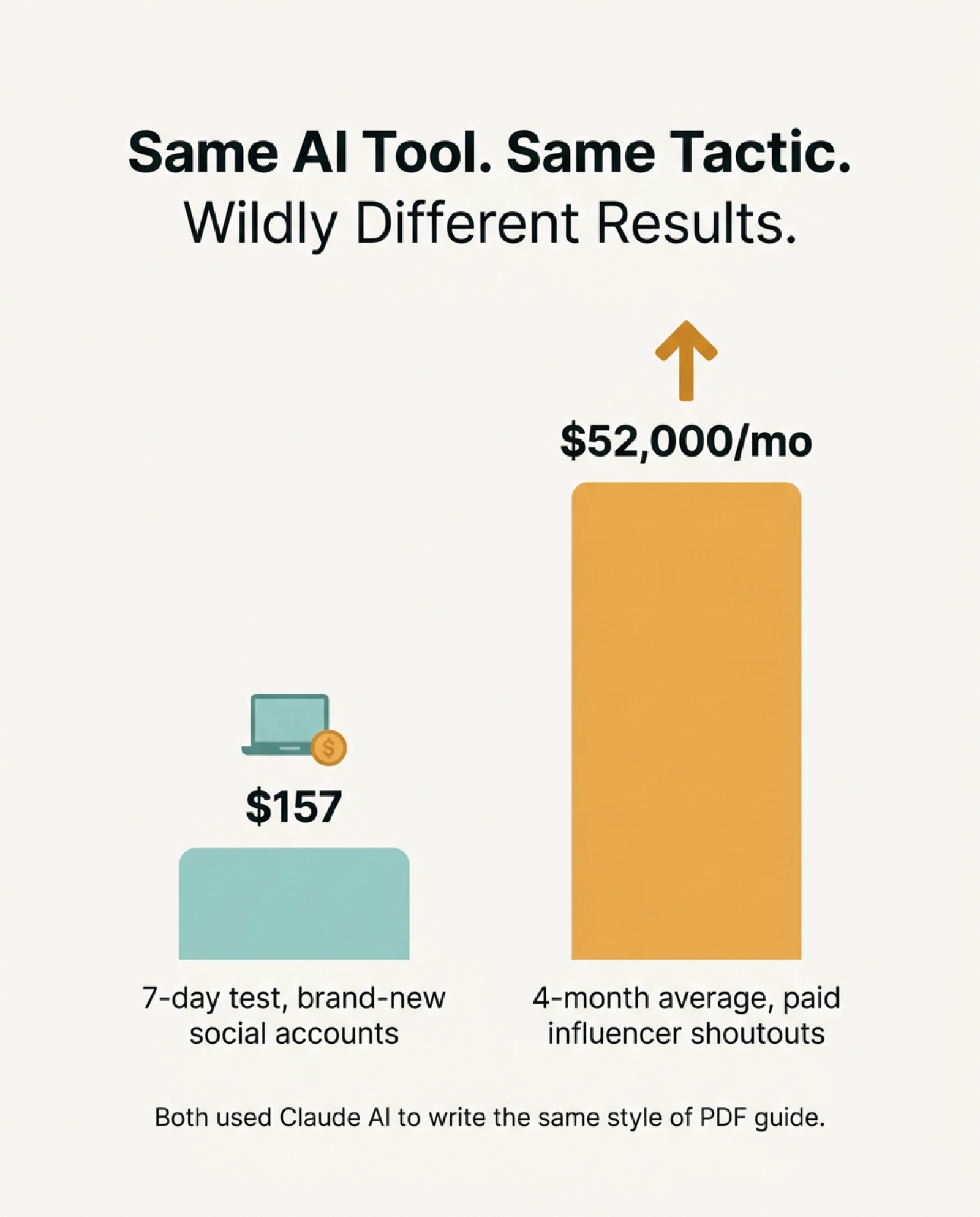
Same AI. Same style of product. Same general selling platform. The difference is that one crew started from zero and the other paid for someone else’s existing audience.
Does AI-assisted dropshipping actually work in 2026?
It works, but the margin sits around 10 to 15 percent after ad spend and refunds, and picking the specific product matters more than the tools you use to find it. Henrik Wold used a product-research tool to find a trending shapewear item, built the store with an AI storefront builder, and reported $75,000 in revenue over 5 weeks with a $3,971 single-day peak, though a roughly 10 percent refund rate (clothing sizing issues) cut into the margin (Henrik Wold).
Sharif Mohsin ran a near-identical process (the same style of TikTok-trend product research plus paid social ads) and got a very different ride. His first product, a lip-plumping balm, returned $66 on $200 of ad spend. His second product got zero sales. His fourth attempt, a pet lick-mat, eventually turned a profit, but the six-day cumulative total was $467.65, and even the best single day ($2,200 in sales) only cleared $267 after $1,268 in ad spend, about a 12 percent margin (Sharif Mohsin). Ethan King’s fidget-toy store followed the same shape: a $2,000 sales day that netted roughly $267 in profit once ad spend and product cost were subtracted (Ethan King).
Three different creators, three different products, the same rough 10 to 15 percent margin ceiling once ads and returns are counted. The product pick, not the AI tooling, decided who broke even and who didn’t. For the design side of a physical-product hustle specifically, our roundup of AI print-on-demand tools breaks down what 15 more creators use for research, design and print-ready files, and our sister site’s free AI product video prompt tool covers the short product-spin clips several of these stores use to boost conversion.
Is “faceless YouTube automation” actually automated?
Not consistently, and two creators running the same style of test reached opposite conclusions about it. Stickman Matt ran a genuinely hands-off pipeline, an AI script tool, an AI voiceover, stock footage, and a hired editor, and still produced real (if modest) results: 14 videos, 103 subscribers, about 4,000 views, and $94 in affiliate revenue over 30 to 40 hours of total work, or roughly $3 an hour (Stickman Matt).
BOOST MIND tried the same style of full automation and got the opposite outcome: three consecutive videos with zero views, flagged by the platform’s own analytics as low quality. The channel only started getting views once the creator stopped letting the AI drive the pacing and started manually directing the visual angles (BOOST MIND). One channel’s “automation works” is another channel’s “automation gets you flagged as robotic,” and the difference seems to be how much human judgment stayed in the editing loop. If a faceless channel is the method you’re leaning toward, see our full breakdown of what 19 creators found running faceless AI YouTube channels, including the one tactic almost everyone warns against. Several of those creators build the channel around one consistent AI host character, our sister site’s character sheet generator is a free way to lock that face in before you start generating video.
Do views actually turn into money?
Not automatically, and the clearest proof of that comes from AI OFM (AI-generated OnlyFans-style content). Tommy Bradshaw’s 14-day, $100-budget test hit almost 100,000 organic views in its first three days with zero ad spend, and by day 10 had reached 1.8 million views and roughly 4,000 followers. Total on-platform earnings for that stretch: somewhere in the $300 to $400 range (Tommy Bradshaw).
The reported cause: audience mismatch. His analytics showed the traffic skewed Android-heavy, mixed gender, and less than 40 percent US, when the accounts that actually convert well in that niche need close to 99 percent US, iOS-heavy, and overwhelmingly male audiences. He had already abandoned his first niche once (an Uber-driver character that hit 200,000+ views and almost no subscribers) before landing on the one that at least converted a little. Views were never the bottleneck. The audience underneath them was.
Which AI side hustle should someone actually start with?
Two creators who don’t know each other independently reached the same conclusion by scoring seven AI money methods each: the crowded, easy-to-start methods score worst, and the harder, less-known B2B methods score best. Make It Rain rated AI clipping and AI-assisted freelance writing at 2 out of 5 due to high competition, while rating AI chatbots for local businesses at 5 out of 5 and AI voice agents at 4 out of 5, both described as “low competition” because most people don’t know the category exists yet (Make It Rain).
Mark Tilbury ran an entirely separate scoring exercise across the same seven-ish categories and landed on the same shape: AI clipping and AI ghostwriting rated “high” competition, while AI agents, AI avatars, and AI app-building all rated “low” (Mark Tilbury). That’s a real point of agreement between two unconnected channels, not a coincidence worth ignoring if you’re picking where to start.
That said, beginner-friendliness claims conflict with effort claims. The How To Channel calls AI-assisted Fiverr copywriting the easiest entry point, citing $650 from 12 small gigs in 30 days, averaging just over $50 a gig (The How To Channel). BOOST MIND’s version of the same tactic required cold-pitching five local businesses to close two clients for $1,000 total, describing it as “grueling manual cold outreach,” not passive at all (BOOST MIND).
How the 19 tests actually broke down
| Creator | Method | Duration | Reported result |
|---|---|---|---|
| Mark Tilbury | AI influencers + digital workbook | 7 days | $157.48 profit ($276 revenue, $99 budget) |
| The How To Channel | 5 methods, separately tested | 30 days each | Fiverr $650, Gumroad $420, faceless YouTube $570, Upwork $1,350, micro SaaS $2,200 pre-orders |
| Stickman Matt | Fully automated faceless YouTube | 30 days | $94 affiliate revenue, 103 subscribers |
| Tommy Bradshaw | AI OFM / Fanvue | 10 of 14 days | 1.8M views, roughly $300 to $400 earned |
| AI Unfiltered | Freelance writing + affiliate + digital products | 30 days | £639 total (missed a £1,000 target) |
| Ethan King | Dropshipping (fidget toy) | 30 days | ~$267 profit on a $2,000 sales day |
| Sharif Mohsin | AI dropshipping, 4 products tested | ~7 days on winner | $467.65 profit after 2 failed products |
| Henrik Wold | Dropshipping (shapewear) | 5 weeks | $75,000 revenue, $3,971 single-day peak |
| Money Talk With Leon | Claude AI PDF guides + paid influencer shoutouts | 4 months | $211,572.11 revenue (~$52,000/month) |
| BOOST MIND | Faceless video, AI copywriting, prompt packs | 30 days | $1,000 from copywriting; prompt packs the only passive result |
| AI Wealth Odyssey | 5 hustles run in parallel | 30 days | Etsy 19 sales, Fiverr 9 orders, KDP 4 sales, POD 3 sales, affiliate 2 commissions |
Frequently asked questions
How much can you realistically make with AI in your first 30 days? Based on these 19 tests, expect somewhere between a small two-digit profit and a few hundred dollars if you’re starting from zero audience, zero budget beyond basic tool subscriptions, and a single method. The five- and six-figure numbers in this roundup all involved either an existing audience, paid promotion through someone else’s audience, or several months of compounding past the 30-day mark.
Is any of this passive income? Partially. AI Wealth Odyssey’s Etsy and Amazon KDP listings kept selling with zero further work after the initial setup, and AI Unfiltered’s affiliate commission was recurring month over month from a single link placed once (AI Wealth Odyssey, AI Unfiltered). Fiverr freelancing and cold-pitched copywriting clients were not passive in any of the 19 tests.
Which tools show up the most across these 19 tests? Claude AI and ChatGPT for writing, Canva for design, Gumroad, Etsy and Shopify for selling digital products, and AutoDS or similar tools for dropshipping fulfillment. None of these creators used a single proprietary system, the tools repeat across nearly every video.
Watch Mark Tilbury’s original 7-day AI-influencer test below for the full walkthrough of how the lowest-budget result in this roundup actually got built.